Showing posts with label Stock Markets. Show all posts

Sunday, March 07, 2021

Indian Stock Market & Gold updates on 7 March 2021 for coming week

 Indian Stock Market & Gold ( international ) updated on 7 March 2021 for coming week

Indian Stock market Nifty

Indian Stock Markets are looking tired, some upward movement steam left, before market can take support at previous higher highs.

Down Support / target for bears = Nifty 13,000 (to establish support for nifty in future)

Internationally Gold continues in bear market, immediate support for gold is at $1500, before gaining any upward trend..

Regarding Crude Oil... with regards to Indian market.. no co relation between the charts and real world prices.. 

Lot of sale inquiries have come regarding Nifty XL trading system, i have started accepting sale orders for Nifty XL trading system.. Please note its in raw format.. that means one has to update it manually at the end of the day to get trend for the next trading day.

Monday, March 01, 2021

Indian Stock Market update on 1 March 2021

 Indian Stock Market update on 1 March 2021


Markets are looking tired, some upward movement steam left, before market can take support at previous higher highs.

Down Support / target for bears = Nifty 13,000 (to establish support for nifty in future)

Sunday, July 31, 2016

WTIC Crude oil Nifty Update on 31 july 2016


WTIC Crude Oil
As expected WTIC crude oil bang in target support of $40

While Indian Nifty (NSE) & Sensex (BSE) stock markets will touch new highs with minor profit bookings as small correction and consolidation happens.

Sunday, July 24, 2016

Indian Stock Markets & Crude Oil WTIC Ahead

Indian Stock Markets & Crude Oil WTIC Ahead

Indian Stock Exchange Nifty 50
 From the chart u can see the NSE's Nifty 50 is moving towards target of 10,000 by Diwali 2016
Crude Oil WTIC
Whereas Crude oil WTIC is moving towards the support of $40 per barrel mark.

Sunday, June 19, 2016

Rexit and effect on Indian Markets

Rexit, Raghuram Rajan's Exit To Hit Rupee, Equities, Say 99% of Analysts while Nifty Equity chart says NO!.

Here is the evidence if AAP member asks for evidence, show them this on a piece of paper.
Nifty Yearly chart

Saturday, June 18, 2016

How To Make Money in Stock Markets

HowTo MakeMoney in StockMarkets and its Recipe for success in stock market

You need :
  • 1 Robust technical Trade signal Reporting system (as its called Trading system) like nifty XL,which tells you, when to trade or when not to trade.
  • As per taste Lot of patience and sharpeye to sniff the trades like sniffer dogs.
  • A pinch of Gamblers luck
  • Suggested garnishing Lot of spare money in form of margin call deposit
How to trade:
Step 1: Wake up early in morning, pray to all powerful almighty (which includes your wife also) for good day ahead.

Step 2: After the market opens, sit idle do nothing (like u do in front of wife) and let the market simmer for 30-45 minutes after opening..

Step 3: Depending situation at home and market... take a call for long or short trade,

Step 4: if hear any negative comments from background, take opposite trade and wait for it to be profitable.

Step 5: wait for a favorable outcome, else close the trade and curse your ancestors for bad luck.

Step 6: strain the trade for brokerage charges and taxes.

Garnish by withdrawing money to bank account.

Enjoy the day in High Spirits (pun intended!). Serves many (Brokers, idlers, exchanges, operators, jobbers, govt, IPOs, banks...etc)

Buyer Beware, We sell it irresponsibly. Harmful to spouses.

More Recipes to come...will update soon

Thursday, April 14, 2016

The Year Ahead for the Stock Markets and Commodities

Happy Baisakhi,Vishu and Bihu folks 

A combined reading of charts shows that the sensex, which is indicative of the mood of the stock market, will have a bullish undertone throughout year. By the time financial year comes to an end, the sensex will be in the range of 28,000-30,000. The nifty will also show healthy growth in range of 8500-9200.

The banks would be forced to declare their real NPA levels in their balance sheet. However, banking sector will gain added momentum and prices of bank shares will show an upward growth, shares of telecommunication, aviation and software companies will show strong growth.

Stocks of television channels and entertainment companies would show uptrend. There will be continued buoyancy in the stock market and this would be the right moment to enter stocks and make healthy profits.

Coming to the commodities market, Due to international trends, there will be in turbulence in gold prices rendering it fairly unstable. As a result, traders are advised to stay away from margin trading in Gold futures, until the period of uncertainty gets over.

Tuesday, April 28, 2015

Nifty Technicals forecast for Tuesday 28-April-2015Nifty

Nifty Technicals forecast for Tuesday 28-April-2015
On 27-April-2015, Nifty closed at:8,213.80(-91.45).
for 28-April-2015, more selling in mkts.

Bearish Head and Shoulders Pattern confirmation on Nifty
Bearish Head and Sholders pattern confirmed on nifty. 

Estimated Target.
(High)9100-8300(low)=800 pts from (Breakdown point) 8300-800(difference)=7500 target on Nifty

Estimated Time of Target Arrival/Completion = 4 months from April 30,2015

Monday, February 02, 2015

Monday, March 24, 2014

Nifty long term and short term update

Some for thought , here is Nifty long term and short term update which i forecast some months back.
two outcomes for nifty. click on the individual pics for reading each posts. thanks in advance

bearish possibility
nifty-technical-forecast-on-17 febuary 2014

bullish possiblity, which is bang on target, given on 21- October - 2013
technical-forecast-given-21-october-2013

Sunday, October 20, 2013

Bullish Head and shoulders on Nifty Technical Forecast for 21 - October - 2013

Technical Forecast for 21 - October - 2013 for Nifty and Sensex

On 18-October-2013, Nifty Closed at:6,189.35 (+143.5) due to weekend factor, for 21-Oct-2013 monday, after day of high range of 156 pts, markets will be range bound in 50-75pts trade range.

head and shoulders pattern in nifty index, Nifty 2013 year chart
Bullish head and shoulders pattern in nifty index
Bullish head and shoulders pattern in nifty index, Target calculation are as follows:
6100(High..approximated) - 5300 (low)= 800points (difference)
6100(High..approximated) + 800points(difference) = Target 6900 on nifty

Estimated Time of Arrival of target (ETA):
pattern start = May(5-2013)
Pattern Close/confirmation = October (10-2013)
difference between start and confirmation= 5 months from 21-oct-2013..
ETA = March-April 2014

Sunday, October 06, 2013

Technical Forecast for 7 - October - 2013 for Nifty and Sensex

Technical Forecast for 7 - October - 2013 for Nifty and Sensex

On 4-October-2013, Nifty Closed at: 5,907.30 (-2.40),so for 7-October-2013, Its Manic Monday.

Daily Nifty Technical Signals:
 Red signal for positions--->
red signal traffic light for danger

Nifty chart 2007 onwards, long term nifty chart, long term nifty trend
Nifty chart 2007 onwards
Year 2013 onwards Nifty chart, Short term trend
Nifty chart 2013 onwards

Sunday, August 25, 2013

Super post - Different Trends for Nifty

Technical Forecast for 26-August- 2013 for Nifty

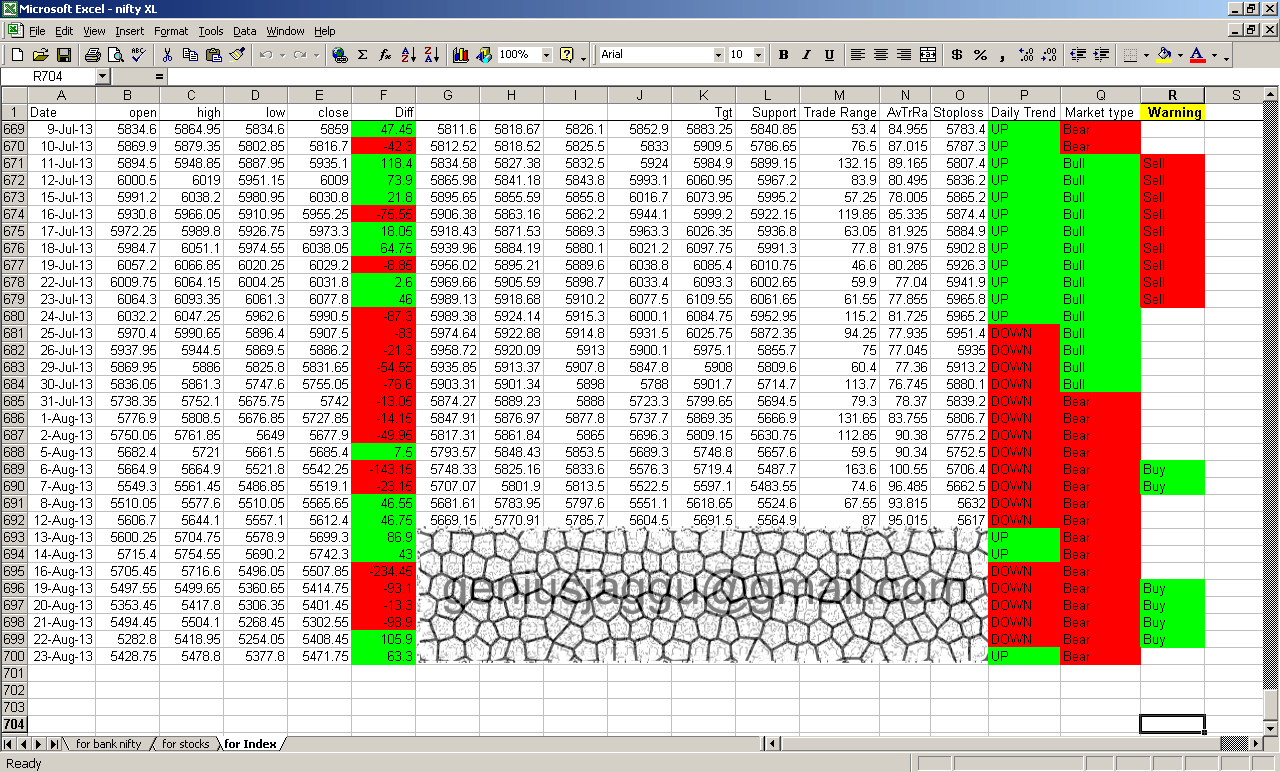
On 23-August-2013, Nifty Closed at:5,471.75 (+63.30 pts) on account of shortcovering by bears, On 26-Aug-2013, short covering may continue in markets.

 Daily trend(as per XL trading system): Uptrend
Market Type(as per XL trading system): bear market

 Daily Nifty Technicals Snapshot:

Different and various year charts for nifty index
long term trend nifty chart of past 10 years, Bull market over, now india in consolidation phase.
2004 onwards nifty 10 year's chart
medium term trend chart  of nifty, past 7 years, with trading range.
2007 onwards nifty 7 year's chart
short term trend chart of nifty, from january 1st, 2013 onwards, head and shoulders pattern clearly   visible with a target of 5000 on Nifty index.
January 2013 onwards nifty chart
In the short term trend Nifty chart, short term trend chart of nifty, from january 1st, 2013 onwards, head and shoulders pattern clearly visible with a target of 5000 on Nifty index.
Timeline returns negative for nifty, start of negative returns for nifty
Timeline returns negative for nifty

Trade Performance of XL trading system

Saturday, July 20, 2013

Excellent Trading School - Types of trading


There are 2 types of Trading. Active and passive

In Passive trading, Investors / Traders will purchase investments / securities with the intention of long-term appreciation in search of elusive multibagger but often end up in money beggars.

Also known as a buy-and-hold or couch potato, doing nothing strategy, passive investing trading requires good initial research, dinosaur-sized patience, a well-diversified portfolio and tons of Fixed Bank deposits.

Unlike active investors, passive investor buy a security and forgets it till one day by mistake he finds his investments multiplied infinite times, typically these Passive investors rely on their belief that in the long term the investment will be profitable. They don't actively attempt to profit from short-term price fluctuations.

Unlike Passive trading, a Active trading is the act of buying and selling securities based on short-term movements to profit from the price movements on a short-term stock chart. The mentality associated with an active trading strategy differs from the long-term, buy-and-hold strategy.

The buy-and-hold strategy employs a great mentality that suggests that price movements over the long term will outweigh the price movements in the short term and, as such, short-term movements should be ignored. Active traders, on the other hand, believe that short-term movements and capturing the market trend are where the profits are made.

There are various methods used to an active-trading. Here are four of the most common types of active trading. Active trading is a popular strategy for those trying to beat the market average.

1. Day Trading
Day trading is perhaps the most well known active-trading style. Day trading, as its name implies, is the method of buying and selling securities within the same day. Positions are closed out within the same day they are taken, and no position is held overnight (Zero risk theory baba!). Traditionally, professional traders who have no other work other than day trading do employ this strategy.

Day Trader definition:
A investor / trader who attempts to profit by making rapid trades intraday. A day trader often closes out all trades before the market close and does not hold any open positions overnight. Some day traders use leverage (extra money loaned from brokers) to magnify the returns generated from small stock price movements

Day trading is often glamorized as an easy path to riches. However, this is rarely the case. Many end up with legs up in streets and mental hospitals, "Day traders typically suffer severe financial losses in their first months of trading, and many never graduate to profit-making status." Day traders are handicapped by the bid-ask spread, trading commissions and expenses for real-time news feeds and financial analysis packages. These costs require day traders to earn significant trading profits just to break even.

2. Position Trading
Some actually consider position trading to be a buy-and-hold strategy and not active trading. However, position trading, when done by an advanced trader, can be a form of active trading. Position trading uses longer term charts - anywhere from daily to monthly - in combination with other methods to determine the trend of the current market direction. This type of trade may last for several days to several weeks and sometimes longer, depending on the trend. Trend traders look for successive higher highs or lower highs to determine the trend of a security. By jumping on and riding the “wave,” trend traders aim to benefit from both the up and downside of market movements. Trend traders look to determine the direction of the market, but they do not try to forecast any price levels. Typically, trend traders jump on the trend after it has established itself, and when the trend breaks, they usually exit the position. This means that in periods of high market volatility, trend trading is more difficult, traders go for much desired sleep and their trading positions are generally reduced.

Definition of 'Position Trader'
A type of trader who holds a position for the long term (from months to years). Long-term traders (who are fed up with the daily boring routine) are not concerned with short-term fluctuations because they believe that their (once mistaken investment if held for) long-term investment horizons will result in good returns.

Many position traders will take a look at weekly or monthly charts to get a sense of where the asset is in a given trend. Position trading is the exact opposite of day trading because in Position trading the goal is to profit from the move in the primary trend rather than the short-term fluctuations that occur day to day.

3. Swing Trading
When a trend breaks, swing traders typically get in the game. At the end of a trend, there is usually some price volatility as the new trend tries to establish itself. Swing traders buy or sell as that price volatility sets in. Swing trades are usually held for more than a day but for a shorter time than trend traders. Swing traders often create a set of trading rules based on technical or fundamental analysis; these trading rules or algorithms are designed to identify when to buy and sell a security. While a swing-trading algorithm does not have to be exact and predict the peak or valley of a price move, it does need a market that moves in one direction or another. A range-bound or sideways market is a risk for swing traders.

Definition of 'Swing Trading'
A style of trading that attempts to capture gains in a stock within one to four days, they have big money bags at home. Swing traders use technical analysis to look for stocks with short-term price momentum. These traders aren't interested in the fundamental or intrinsic value of stocks, but rather in their price trends and patterns.

'Swing Trading'
To find situations in which a stock has the extraordinary potential to move in such a short time frame, the trader must act quickly. Therefore, at-home and day traders mainly use swing trading. Large institutions trade in sizes too big to move in and out of stocks quickly. The individual trader is able to exploit such short-term stock movements without having to compete with the major traders.

4. Scalping
Scalping is one of the quickest strategies employed by active traders. It includes exploiting various price gaps caused by bid/ask spreads and order flows. The strategy generally works by making the spread or buying at the bid price and selling at the ask price to receive the difference between the two price points. Scalpers attempt to hold their positions for a short period, thus decreasing the risk associated with the strategy. Additionally, a scalper does not try to exploit large moves or move high volumes; rather, they try to take advantage of small moves that occur frequently and move smaller volumes more often. Since the level of profits per trade is small, scalpers look for more liquid stocks/markets to increase the frequency of their trades. And unlike swing traders, scalpers like quiet markets that aren't prone to sudden price movements so they can potentially make the spread repeatedly on the same bid/ask prices.

Definition of 'Scalper'
A person trading in the equities or options and futures market who holds a position for a very short period of time in an attempt to profit from the bid-ask spread.

The rapid trading that occurs in legitimate scalping usually results in small gains, but several small gains can add up to large returns at the end of the day. There is also an illegal type of scalping in investments in which an investment advisor purchases a security, recommends it as an investment, watches the price increase based on his recommendation, then sells the security for a profit, in local parlance, they are called operators nemesis of the investors.

New traders / Beginners can employ one or many of the mentioned strategies. However, before deciding on engaging in these strategies, the risks and costs associated with each one need to be explored and considered.

Thursday, July 18, 2013

Meaning of Overbought and Oversold


Meaning of Overbought:
A stock or commodity market condition where there has been significant trading bidding up prices to higher levels, levels which seem overextended by common man's arms reach.

Overbought is a term used to describe a market or a stock that has appreciated so rapidly and has generated such excessively bullish sentiment that a near-term decline is highly likely

In technical analysis, it is a market in which the volume of buying that has occurred is greater than the fundamentals justify.

Is a technical opinion that the market price has risen too steeply and too fast in relation to underlying fundamental factors. It is important to keep in mind that overbought is not necessarily the same as being bearish. It merely infers that the stock has risen too far too fast and might be due for a pullback.

A physical asset or futures contract whose prices have been pushed up to a level that some believe is unrealistically high and cannot be sustained ie. when the speculative long interest has rapidly increased and the speculative short interest is sharply reduced.

Meaning of Oversold:
Oversold is a term used to describe a technical opinion of a market has declined too steeply and too fast in relation to underlying fundamental factors

An analytical term for a stock that is underpriced a condition of the marked after an abrupt recession. In this situation a correction rise is possible

A technical condition that occurs when prices are considered too low and ripe for a rally. It is important to keep in mind that oversold is not necessarily the same as being bullish. It merely infers that the security has fallen too far too fast and may be due for a reaction rally.

Its the reverse of overbought. A single security or a market which, it is believed, has declined to an unreasonable level. A market which has fallen too far and too fast under excessive selling pressure and is expected to move back to a higher, more neutral level.

Used in the context of general equities. Technically too low in price, and hence a technical correction is expected. Antithesis of overbought

A physical asset or futures contract whose prices have been pushed down to a level that some believe is unrealistically low and cannot be sustained ie. when the speculative long interest has been drastically diminished and the speculative short interest increases.

Saturday, April 06, 2013

Techincal Analysis - Basics of Support And Resistance


Support And Resistance

You'll often hear technical analysts talk about the ongoing battle at  price points  of resistance and support between the bulls and the bears, or the struggle between buyers (demand) and sellers (supply). This is because the prices of a security seldom move above (resistance) or below (support).
Why it Happen?
Support and Resistance levels are seen as important in terms of market psychology and supply and demand. Support and resistance levels are the levels at which a lot of traders are willing to buy the stock (in the case of a support) or sell it (in the case of resistance). When these trendlines are broken, the supply and demand and the psychology behind the stock's movements is thought to have shifted, in which case new levels of support and resistance will be established.
Importance of Round Numbers for  Support and Resistance
One type of universal support and resistance that tends to be seen across a large number of securities is round numbers. Round numbers like 10, 20, 50, 100, 250, 500 and 1,000 tend be important in support and resistance levels because they often represent the major psychological turning points at which many traders will make buy or sell decisions.

Buyers will often purchase large amounts of stock once the price starts to fall toward a major round number such as Rs.50, Rs.100 which makes it more difficult for shares to fall below the level. On the other hand, sellers start to sell off a stock as it moves toward a round number peak such as, Rs.100 or Rs.1000 making it difficult to move past this upper level as well. It is the increased buying and selling pressure and major psychological points at these levels that makes them important points of support and resistance.

Once a resistance or support level is broken, its role is reversed. If the price falls below a support level, that level will become resistance. If the price rises above a resistance level, it will often become support. As the price moves past a level of support or resistance, it is thought that supply and demand has shifted, causing the breached level to reverse its role. For a true reversal to occur, however, it is important that the price make a strong move through either the support or resistance.

The Importance of Support and Resistance
Support and resistance analysis is an important because it can be used to make trading decisions and identify when a trend is reversing. For example, if a trader identifies an important level of resistance that has been tested several times but never broken, they may decide to take profits as the security moves toward this point because it is unlikely that it will move past this level.

Support and resistance levels both test and confirm trends and need to be monitored by anyone who uses technical analysis. As long as the price of the share remains between these levels of support and resistance, the trend is likely to continue. It is important to note, however, that a break beyond a level of support or resistance does not always have to be a reversal.

Being aware of these important support and resistance points should affect the way that you trade a stock. Traders should avoid placing orders at these major points, as the area around them is usually marked by a lot of volatility. 

If you feel confident about making a trade near a support or resistance level, it is important that you follow this simple rule: do not place orders directly at the support or resistance level. This is because in many cases, the price never actually reaches the whole number, but flirts with it instead. 

So if you're bullish on a stock that is moving toward an important support level, do not place the trade at the support level.

 Instead, place it above the support level, but within a few points. On the other hand, if you are placing stops or short selling, set up your trade price at or below the level of support.

Tuesday, February 26, 2013

Excellent Trading School - 29 - Frequently Asked Questions about Options Contracts - Part 5 (Options Strategies)


Question: What are Strip and Strap strategies?
Answer: These strategies are quite similar to Straddle. The only difference is that unlike straddle, call and put options are not bought in equal numbers.

In Strip strategy, the number of puts bought or sold is double that of call options.
In Strap, the number of calls bought or sold is double that of put options.

You buy strip when you expect sharp movement in the prices of the underlying but are a little biased towards downward movement, so you buy more put than call options. 

Likewise while buying strap you are little biased towards upward movement, you buy more call than put options.

You sell strip when you expect the price to fluctuate in a narrow range but you also believe that in case the price moves beyond the range, it would move upward, so you sell more put than call options.

Likewise while selling strap you are a little biased toward downward movement of the underlying price in case it breaks the range.

Question: I believe that the underlying will fluctuate in a narrow range but am not very sure of it moving sharply in either direction. What should be my strategy? What is the upside potential and downside risk? What happens as time passes?
Answer: When you believe that the underlying will fluctuate in a narrow range but are not very sure of it moving sharply in either direction, Long Butterfly is the best strategy.
Strategy implementation: buy one in-the-money call, sell two at-the-money calls and buy one out-of-the-money call option. The same strategy can be implemented using put options also. It is difficult to execute four transactions simultaneously. As such there is execution risk involved.
Upside potential: the profit is limited to the extent of the difference between the lower and middle strike prices minus initial debit.
Downside risk: the loss is limited to the extent of initial debit.
Time decay characteristic: time works against.

Question: I am not sure of the direction and am fairly certain that the underlying is going to rise or fall sharply. What strategy should I follow? What is the upside potential and downside risk? What happens as time passes?
Answer: When you are not so sure that the underlying index or stock will rise or fall sharply and are not certain about the direction, Short Butterfly is the best strategy. Strategy implementation: sell one in-the-money call, buy two at-the-money calls and sell one out-of-the-money call option. The same strategy can be implemented using put options also. It is difficult to execute four transactions simultaneously. As such there is execution risk involved.
Upside potential: the profit is limited to the extent of initial credit received.
Downside risk: the loss is limited to the extent of the difference between the lower and middle strike prices minus initial credit received.

Excellent Trading School - 28 - Frequently Asked Questions about Options Contracts - Part 4

Question: How does the margin system work in option trading?
Answer: Since the risk of the buyer of an option is limited to the premium paid, there is no margin required from the buyer of the option. The buyer’s cost is limited to the premium paid. The risk of the option seller is unlimited and therefore he needs to pay the margin as prescribed by the exchange at the time of entering into an option contract. To reduce the default risk, the option position of the seller is marked to market every day.

Question: If I have two opposite positions in futures and options, then do I have to pay margin on both the positions?
Answer: You have to pay margin on your positions but the net margin required is lower than the margin on two separate positions. Suppose you have sold one futures contract on ACC at Rs152 and simultaneously bought an ACC call option with a strike price of Rs160 at Rs5. In this portfolio one position is bullish and the other bearish, so in case ACC’S price goes up, one position would gain and the other would lose. Similarly if ACC’S price goes down, one position would gain while the other would lose. These are hedging positions. Hence the margin is less.

Question: How are options different from futures?
Answer: In case of futures, both the buyer and the seller are under obligation to fulfill the contract. They have unlimited potential to gain if the price of the underlying moves in their favour. On the contrary, they are subject to unlimited risk of losing if the price of the underlying moves against their views.
In case of options, however, the buyer of the option has the right and not the obligation. Thus he enjoys an asymmetric risk profile. He has unlimited potential to profit if the price of the underlying moves in his favour. But a limited potential to lose, to the extent of the premium paid, in case the price of the underlying moves against the view taken.

Similarly the seller of the option is under obligation. He has limited potential to profit, to the extent of the premium received, in case the price of the underlying moves in his favour. But an unlimited risk of losing in case the price of the underlying moves against the view taken.

Question: How are options different from futures in terms of price behaviour?
Answer: Trading in futures is one-dimensional as the price of futures depends upon the price of the underlying only. Trading in option is two-dimensional as the price of an option depends upon both the price and the volatility of the underlying.

Question: I want to know all about the behaviour of the price of an option?
Answer: You need to understand and appreciate various option Greeks like delta, gamma, theta, vega and rho to completely comprehend the behaviour of option prices.

Question: What is delta of an option and what is its significance?
Answer: For a given price of underlying, risk-free interest rate, strike price, time to maturity and volatility, the delta of an option is a theoretical number. If any of the above factors changes, the value of delta also changes.

The delta of an option tells you by how much the premium of the option would increase or decrease for a unit change in the price of the underlying. For example, for an option with delta of 0.5, the premium of the option would change by 50 paise for a Rs1 change in the price of the underlying. Delta is about 0.5 for near/at the money options. As the option becomes in the money, the value of delta increases.

Conversely as the option becomes out of the money, the value of delta decreases. In other words, delta measures the sensitivity of options with respect to change in the price of the underlying. Deep out-of-the-money options are less sensitive in comparison to at-the-money and deep in-the-money options.

Delta is positive for a bullish position (long call and short put) as the value of the position increases with rise in the price of the underlying. Delta is negative for a bearish position (short call and long put) as the value of the position decreases with rise in the price of the underlying.

Delta varies from 0 to 1 for call options and from –1 to 0 for put options. Some people refer to delta as 0 to 100 numbers.

The Delta is an important piece of information for a option Buyer because it can tell him much of an option & buyer he can expect for short-term moves by the underlying stock. This can help the Buyer of an option which call / Put option should be bought. The factors which can change the Delta of an option are Stock Price, Volitility & No. of Days.

Question: What is theta of an option and its significance?
Answer: The theta of an option is an extremely significant theoretical number for an option trader. Like the other Greek terms you can calculate theta using option calculator.

Theta tells you how much value the option would lose after one day, with all the other parameters remaining the same.

Suppose the theta of Infosys 30-day call option with a strike price of Rs3,900 is 4.5 when Infosys is quoting at Rs3,900, volatility is 50% and the risk-free interest rate is 8%. This means that if the price of Infosys and the other parameters like volatility remain the same and one day passes, the value of this option would reduce by Rs4.5.

Theta is always negative for the buyer of an option, as the value of the option goes down each day if his view is not realised. Conversely theta is always positive for the seller of an option, as the value of the position of the seller increases as the value of the option goes down with time.

Consider options as depreciating assets because of time decay and appreciating due to favourable price movements. If the rate of appreciation is more than that of depreciation hold the option, else sell it off. Further, time decay of option premium is very steep near expiry of the option. The following graph would make it clearer.

Question: What is vega of an option and its significance?
Answer: Vega is also a theoretical number that can be calculated using an option calculator for a given set of values of underlying price, time to expiry, strike price, volatility and interest rate etc. Vega indicates how much the option premium would change for a unit change in annual volatility of the underlying.

Suppose the vega of an option is 0.6 and its premium is Rs15 when volatility of the underlying is 35%. As the volatility increases to 36%, the premium of the option would change upward to Rs15.6.

Vega is positive for a long position (long call and long put) and negative for a short position (short call and short put).

Simply put, for the buyer it is advantageous if the volatility increases after he has bought the option. On the other hand, for the seller any increase in volatility is dangerous as the probability of his option getting in the money increases with any rise in volatility.

Sometimes you might have observed that though seven to ten days have passed after you bought an option, the underlying price is almost in the same range while the premium of the option has increased. This clearly indicates that volatility of the underlying might have increased.

Question: What is gamma of an option and its significance?
Answer: Gamma is a sophisticated concept. You need patience to understand it as it is important too. Like delta, the gamma of an option is a theoretical number. Feeding the price of underlying, risk-free interest rate, strike price, time to maturity and volatility, you can compute value of gamma using the option calculator. The gamma of an option tells you how much the delta of an option would increase or decrease for a unit change in the price of the underlying.

For example, assume the gamma of an option is 0.04 and its delta is 0.5. For a unit change in the price of the underlying, the delta of the option would change to 0.5 + 0.04 = 0.54. The new delta of the option at changed underlying price is 0.54; so the rate of change in the premium has increased.

If I were to explain in very simple terms: if delta is velocity, then gamma is acceleration. Delta tells you how much the premium would change; gamma changes delta and tells you how much the next premium change would be for a unit price change in the price of the underlying.

Gamma is positive for long positions (long call and long put) and negative for short positions (short call and short put). Gamma does not matter much for options with long maturity. However for options with short maturity, gamma is high and the value of the options changes very fast with swings in the underlying prices.

Excellent Trading School - 27 - Frequently Asked Questions about Options Contracts - Part 3

Question: When is an option called in-the-money option?
Answer: Those options, which have certain intrinsic value, are called in the money, by virtue of the fact that they are holding some money right now.
For example, when SBI is quoting at Rs200, an SBI call option with Rs190 strike price is in the money because you have the right to buy at a price lower than the market price of the underlying. All those call options, which have their strike price lower than the spot price of the underlying are in the money.
Similarly when SBI is quoting at Rs200, an SBI put option with Rs210 strike price is in the money because you have the right to sell at a price higher than the spot price of the underlying. All those put options, which have their strike price higher than the spot price of the underlying are in the money.

Question: When is an option called out of the money?
Answer: Those options whose intrinsic value is zero are called out of the money, by virtue of the fact that they are not holding any money right now. For example, when SBI is quoting at Rs200, an SBI call option with Rs220 strike price is out of the money because you have the right to buy at higher price than the spot price of the underlying. All those call options which have their strike price higher than the spot price of the underlying are out of the money.
Similarly when SBI is quoting at Rs200, an SBI put option with Rs180 strike price is out of the money because you have the right to sell at a price lower than the spot price of the underlying. All those put options, which have their strike price lower than the spot price of the underlying are out of the money.

Question: When is an option called near or at the money?
Answer: Those options, which have their strike price closest to the spot price of the underlying are called near-the-money options because these options are due to get in or out of the money. The options whose strike price is the same as the spot price of the underlying are called at-the-money options.

Question: Are options permanently at, in or out of the money?
Answer: No. Options are not permanently in, at or out of the money. It is the movement of the spot price that makes the options in, at or out of the money. The same option which is in the money can become out of the money when the price moves adversely.

Question: How does settlement of the option take place on exercise/expiry?
Answer: Presently stock options are settled in cash. This means that when the buyer of the option exercises an option, he receives the difference between the spot price and the strike price in cash. The seller of the option pays this difference.

 It is expected that stock options would be settled by delivery of the underlying stock. This means that on exercise of a call option, a long position of the underlying stock effectively at the strike price would be transferred in the cash segment in the account of the buyer of the call option who has the right to buy. An opposite short position at effectively the strike price would be transferred in the cash segment in the account of the seller of the call option who has obligation to sell.

Similarly on exercise of a put option, a short position in the underlying stock effectively at the strike price would be transferred in the cash segment in the account of the buyer of the put option who has the right to sell. An opposite long position at effectively the strike price would be transferred in the cash segment in the account of the seller of the put option who has the obligation to buy.

Question: How is the seller chosen against whom the obligation is assigned?
Answer: When a buyer exercises his option, the exchange randomly selects a seller at client level and assigns the obligation against him. This process is called assignment. The seller of an option should be alert all the time as it is possible that an option could be assigned against him. Your broker would inform you about such an assignment.

Question: What can I do with the position so transferred in my account in the cash segment?
Answer: It totally depends upon you. You can square up your position or let it go for the settlement on T+2 days. You receive the shares on payment of money if you have long position. You receive money against delivery of shares if you have short position.

Question: What happens in case the buyer of an option forgets to exercise his option till expiry?
Answer: On the day of expiry if the option is in the money, the exchange automatically exercises it and pays the difference between the settlement/closing price and the strike price to the buyer. The seller of the option pays this difference.

Question: How does the time value vary for at-, in- and out-of-the-money
options?
Answer: The following graph shows how the premium of 30-day maturity, Rs260 strike price call option on Reliance varies with the movement of the spot price of Reliance. Study the price movement of the option carefully. You would find that the time value is the highest when the spot price is equal to the strike price, the option is at the money. As the spot price rises above the strike price, the option becomes in the money and its intrinsic value increases but its time value decreases. In the same way as the spot price falls below the strike price, the option becomes out of the money and its intrinsic value becomes zero while its time value decreases.

Question: How does option premium vary with maturity of the option?
Answer: The buyers of longer maturity options enjoy the right to longer duration and the sellers are subject to risk of price movement of the underlying during a longer term, since the price of both call and put options increases as the time to expiry increases.

Question: How does option premium vary with risk-free interest rate?
Answer: As the risk-free rate of interest increases, the price of call options increases and that of put options decreases and vice-versa.

Question: How does the price of an option vary with the movement of the spot price of the underlying?
Answer: As the spot price of the underlying rises, the value of the call option increases and that of put options decreases. As the spot price of the underlying falls, the price of the call option decreases and that of the put option increases.

Question: What happens to my position in the options contract when corporate announcements like dividend, bonus, stock split, rights etc are made?
Answer: Good question. In the event of such corporate announcements, the exchanges adjust the option positions such that the economical value of your position on the cum-benefit day and the ex-benefit day is the same.

Question: Please explain these adjustments with the help of some examples. What is the effect of dividend on options?
Answer: According to Sebi regulations, if the value of the declared dividend is more than 10% of the spot price of the underlying on the day of dividend announcement, on ex-dividend date the strike price of the options on a stock are reduced by the dividend amount. In case the declared dividend is lower than 10% of the spot price, then there is no adjustment for the dividend by the exchange and the market adjusts the price of options taking the dividend into consideration.

Suppose Reliance is trading at Rs260 and it announces a dividend of Rs30 per share. Since it is more than 10% of the prevailing market price, all the available strike price of Reliance options get reduced by Rs30 on ex-dividend date. The option with strike price of Rs260 stands at Rs230 and so on. If you are long on Reliance call 260. Your position on ex-dividend date would become long on Reliance call 230.

At the same time ACC is trading at Rs160 and it announces a dividend of Rs2 per share. Since it is lower than 10% of the underlying price, no change is made in the option contracts of ACC. The ACC option with a strike price of Rs160 on last cum-dividend date will remain as Rs160 strike price on ex-dividend date. The stock price reduces by the dividend amount on the ex-dividend date. This means the call option price decreases and the put option price increases on exdividend date. In reality the market adjusts the option price as soon as the dividend is announced.

Question: How does bonus affect my position in stock options?
Answer: The lot size and strike price of the stock option contract gets adjusted according to the bonus ratio. For example: if Infosys announces a bonus of 1:1, then the market lot of Infosys changes from 100 shares to 200 shares on ex- bonus day and the strike price of all the options on Infosys are reduced to half. Suppose you are short 100 Infosys put 4300, on ex-bonus day your position would become short 200 Infosys put 2150.

Excellent Trading School - 26 - Frequently Asked Questions about Options Contracts - Part 2


Question: What are the factors that affect the price of an option?
Answer: There are five fundamental factors that affect the price of an option.These are:
1. Price of the underlying stock or index
2. Strike price/exercise price of the option
3. Time to expiration of the option
4. Risk-free rate of interest
5. Volatility of the price of underlying stock or index
Adjust the price for dividend expected during the term of the option to arrive at prices.

Question: What is volatility?
Answer: Volatility is the measure of speed of the movement of underlying prices.In other words it is the probability of the movement of underlying prices. For example, when it is said that daily volatility of the closing price of a stock is 2%, it means that there is 50% probability that the stock price can go up or down 2% from its previous close.
Question: Can you explain how the probability of price movement of the underlying helps to find the price of an option?
Answer: Consider this: suppose a stock is trading at Rs70. There is 40% probability that the stock price would move to Rs80. Similarly the probabilities of the price being Rs90, Rs100, Rs110 and Rs120 are 25%, 15%, 10% and 5% respectively. What would be your expected return if you were the buyer of a call option with a strike price of Rs100? If the stock price were to finish at Rs80, Rs90 and Rs100, the call option would expire worthless. If the stock price were to finish at Rs110 or Rs120, you would gain Rs10 and Rs20 respectively. Your expected return from the call would be: (40%*0)+(25%*0)+(15%*0)+(10%*10)+(5%*20) = 11.
This means that you would like to pay anything less than Rs11 for this option to make a profit and the seller would always like to get anything more than Rs11 for giving you this option.

Question: What happens in the real world?
Answer: It is possible to take “n” number of prices and assign different probability
numbers to each of the price to compute the expected return and the value of an
option. But in real world there are infinite number of possibilities and this approach
of computing price is not feasible. Alternatively, the volatility figure, which is nothing
but indicated probability, is taken to find the price of an option.

Question: Is there an easier way to find the theoretical price of an option?
Answer: Yes, there are scientific formulae available to compute the theoretical value of an option. The most popular mathematical model for computing the price of European style options is known as Black & Scholes model. Binomial model is used to find the fair value of premium of American style options. These formulae are complex mathematical functions and need fair amount of understanding of differential calculus, a branch of mathematics. Instead of spending too much effort in understanding the formulae, it is prudent to use ready-made tools for computing option prices. There are Excel sheets and software available for computing option prices which apply these algorithms. Put in the value of the five factors of an option into the software to find the theoretical price of the option.

Question: Can you explain option pricing with an example?
Answer: What would be the value of a June 27, 2012 Reliance Industries call option with Rs.300 strike price when Reliance Industries is trading at Rs.320, there are 30 days remaining in expiry, the risk-free interest rate is 8% and annual volatility of Reliance Industries’ price is 48%. Put in the value of the five factors in the option calculator, Suppose this price is Rs.35...

Question: I understand the price can be Rs.20 as I am getting the right to buy Reliance Industries shares at Rs.300 when Reliance Industries is quoting at Rs.320. Can you explain why I should pay Rs.35 for this option?
Answer: The difference of Rs.20 between the strike price and the spot price is the value this option is holding right now. If you pay Rs.20 and immediately exercise the option, you would neither gain nor lose. But this option is giving you the right to buy Reliance Industries shares at Rs.300 till June 27, 2012, which is 30 days away. The seller would like to get something for the risk of price rise during this period. Hence Rs15 (premium minus intrinsic value) is the time value of the option.

Question: Can you explain the pricing of a put option with an example?
Answer: What would be the value of an August 29, 2012 RIL  put option with Rs800 strike price when RIL is trading at Rs750, there are 30 days remaining in expiry, the risk-free interest rate is 8% and the annual volatility of RIL price is  40% Put in the value of the five factors in the option calculator, you find the price is Rs75...

Question: I can understand the price can be Rs.50 as I am getting the right to sell RIL shares at Rs.800 when RIL is quoting at Rs750. Can you explain why I should pay Rs75 for this option?
Answer: The difference of Rs50 between the spot and the strike price is the value this option is holding right now. If you pay Rs50 and exercise the option immediately, you would neither gain nor lose. But this option is giving you the right to sell ITC shares at Rs800 till August 29, 2002, which is 30 days away. The seller would like to get some money for the risk of price falling during this period. The time value of the option is Rs25 (premium minus intrinsic value).

Question: Can I say that premium is the sum of intrinsic and time value of option?
Answer: Yes. You can divide the premium of an option into two components:
intrinsic value and time value.

Question: Would the intrinsic value of a Reliance Industries call option with Rs.340 strike price be negative when Reliance Industries is quoting at  Rs320?
Answer: No. The intrinsic value of an option is never negative, though it can be zero. The entire premium of such options consists of time value only.

Question: Can time value be negative?
Answer: No. Like intrinsic value, time value too is never negative, though it can be zero.

Question: What is extrinsic value?
Answer: Extrinsic value is nothing but another term used to describe time value.

Popular Posts for last 7 days

All Time Popular Posts