Showing posts with label TA for beginners. Show all posts

Monday, March 01, 2021

Indian Stock Market update on 1 March 2021

 Indian Stock Market update on 1 March 2021


Markets are looking tired, some upward movement steam left, before market can take support at previous higher highs.

Down Support / target for bears = Nifty 13,000 (to establish support for nifty in future)

Sunday, October 20, 2013

Bullish Head and shoulders on Nifty Technical Forecast for 21 - October - 2013

Technical Forecast for 21 - October - 2013 for Nifty and Sensex

On 18-October-2013, Nifty Closed at:6,189.35 (+143.5) due to weekend factor, for 21-Oct-2013 monday, after day of high range of 156 pts, markets will be range bound in 50-75pts trade range.

head and shoulders pattern in nifty index, Nifty 2013 year chart
Bullish head and shoulders pattern in nifty index
Bullish head and shoulders pattern in nifty index, Target calculation are as follows:
6100(High..approximated) - 5300 (low)= 800points (difference)
6100(High..approximated) + 800points(difference) = Target 6900 on nifty

Estimated Time of Arrival of target (ETA):
pattern start = May(5-2013)
Pattern Close/confirmation = October (10-2013)
difference between start and confirmation= 5 months from 21-oct-2013..
ETA = March-April 2014

Sunday, September 08, 2013

Technical Forecast for 10 - September - 2013 for Nifty with charts

Technical Forecast for 10 - September - 2013 for Nifty

On 6-September-2013, Nifty Closed at:5,680.40 (+87.45) on account of short covering due to long weekend and holiday on Monday. On 10-September-2013,this week, Nifty will be in range bound trading zone of 5800-5600.

 Daily trend(as per XL trading system):-
Market Type(as per XL trading system): bear market

 Daily Nifty Technicals Snapshot:

short term trend chart of nifty, from january 1st, 2013 onwards, head and shoulders pattern clearly   visible with a target of 5000 on Nifty index.
January 2013 onwards nifty chart
Trade Performance of XL trading system
Timeline returns negative for nifty, start of negative returns for nifty
Timeline returns negative for nifty

Saturday, July 20, 2013

Excellent Trading School - Types of trading


There are 2 types of Trading. Active and passive

In Passive trading, Investors / Traders will purchase investments / securities with the intention of long-term appreciation in search of elusive multibagger but often end up in money beggars.

Also known as a buy-and-hold or couch potato, doing nothing strategy, passive investing trading requires good initial research, dinosaur-sized patience, a well-diversified portfolio and tons of Fixed Bank deposits.

Unlike active investors, passive investor buy a security and forgets it till one day by mistake he finds his investments multiplied infinite times, typically these Passive investors rely on their belief that in the long term the investment will be profitable. They don't actively attempt to profit from short-term price fluctuations.

Unlike Passive trading, a Active trading is the act of buying and selling securities based on short-term movements to profit from the price movements on a short-term stock chart. The mentality associated with an active trading strategy differs from the long-term, buy-and-hold strategy.

The buy-and-hold strategy employs a great mentality that suggests that price movements over the long term will outweigh the price movements in the short term and, as such, short-term movements should be ignored. Active traders, on the other hand, believe that short-term movements and capturing the market trend are where the profits are made.

There are various methods used to an active-trading. Here are four of the most common types of active trading. Active trading is a popular strategy for those trying to beat the market average.

1. Day Trading
Day trading is perhaps the most well known active-trading style. Day trading, as its name implies, is the method of buying and selling securities within the same day. Positions are closed out within the same day they are taken, and no position is held overnight (Zero risk theory baba!). Traditionally, professional traders who have no other work other than day trading do employ this strategy.

Day Trader definition:
A investor / trader who attempts to profit by making rapid trades intraday. A day trader often closes out all trades before the market close and does not hold any open positions overnight. Some day traders use leverage (extra money loaned from brokers) to magnify the returns generated from small stock price movements

Day trading is often glamorized as an easy path to riches. However, this is rarely the case. Many end up with legs up in streets and mental hospitals, "Day traders typically suffer severe financial losses in their first months of trading, and many never graduate to profit-making status." Day traders are handicapped by the bid-ask spread, trading commissions and expenses for real-time news feeds and financial analysis packages. These costs require day traders to earn significant trading profits just to break even.

2. Position Trading
Some actually consider position trading to be a buy-and-hold strategy and not active trading. However, position trading, when done by an advanced trader, can be a form of active trading. Position trading uses longer term charts - anywhere from daily to monthly - in combination with other methods to determine the trend of the current market direction. This type of trade may last for several days to several weeks and sometimes longer, depending on the trend. Trend traders look for successive higher highs or lower highs to determine the trend of a security. By jumping on and riding the “wave,” trend traders aim to benefit from both the up and downside of market movements. Trend traders look to determine the direction of the market, but they do not try to forecast any price levels. Typically, trend traders jump on the trend after it has established itself, and when the trend breaks, they usually exit the position. This means that in periods of high market volatility, trend trading is more difficult, traders go for much desired sleep and their trading positions are generally reduced.

Definition of 'Position Trader'
A type of trader who holds a position for the long term (from months to years). Long-term traders (who are fed up with the daily boring routine) are not concerned with short-term fluctuations because they believe that their (once mistaken investment if held for) long-term investment horizons will result in good returns.

Many position traders will take a look at weekly or monthly charts to get a sense of where the asset is in a given trend. Position trading is the exact opposite of day trading because in Position trading the goal is to profit from the move in the primary trend rather than the short-term fluctuations that occur day to day.

3. Swing Trading
When a trend breaks, swing traders typically get in the game. At the end of a trend, there is usually some price volatility as the new trend tries to establish itself. Swing traders buy or sell as that price volatility sets in. Swing trades are usually held for more than a day but for a shorter time than trend traders. Swing traders often create a set of trading rules based on technical or fundamental analysis; these trading rules or algorithms are designed to identify when to buy and sell a security. While a swing-trading algorithm does not have to be exact and predict the peak or valley of a price move, it does need a market that moves in one direction or another. A range-bound or sideways market is a risk for swing traders.

Definition of 'Swing Trading'
A style of trading that attempts to capture gains in a stock within one to four days, they have big money bags at home. Swing traders use technical analysis to look for stocks with short-term price momentum. These traders aren't interested in the fundamental or intrinsic value of stocks, but rather in their price trends and patterns.

'Swing Trading'
To find situations in which a stock has the extraordinary potential to move in such a short time frame, the trader must act quickly. Therefore, at-home and day traders mainly use swing trading. Large institutions trade in sizes too big to move in and out of stocks quickly. The individual trader is able to exploit such short-term stock movements without having to compete with the major traders.

4. Scalping
Scalping is one of the quickest strategies employed by active traders. It includes exploiting various price gaps caused by bid/ask spreads and order flows. The strategy generally works by making the spread or buying at the bid price and selling at the ask price to receive the difference between the two price points. Scalpers attempt to hold their positions for a short period, thus decreasing the risk associated with the strategy. Additionally, a scalper does not try to exploit large moves or move high volumes; rather, they try to take advantage of small moves that occur frequently and move smaller volumes more often. Since the level of profits per trade is small, scalpers look for more liquid stocks/markets to increase the frequency of their trades. And unlike swing traders, scalpers like quiet markets that aren't prone to sudden price movements so they can potentially make the spread repeatedly on the same bid/ask prices.

Definition of 'Scalper'
A person trading in the equities or options and futures market who holds a position for a very short period of time in an attempt to profit from the bid-ask spread.

The rapid trading that occurs in legitimate scalping usually results in small gains, but several small gains can add up to large returns at the end of the day. There is also an illegal type of scalping in investments in which an investment advisor purchases a security, recommends it as an investment, watches the price increase based on his recommendation, then sells the security for a profit, in local parlance, they are called operators nemesis of the investors.

New traders / Beginners can employ one or many of the mentioned strategies. However, before deciding on engaging in these strategies, the risks and costs associated with each one need to be explored and considered.

Thursday, July 18, 2013

Meaning of Overbought and Oversold


Meaning of Overbought:
A stock or commodity market condition where there has been significant trading bidding up prices to higher levels, levels which seem overextended by common man's arms reach.

Overbought is a term used to describe a market or a stock that has appreciated so rapidly and has generated such excessively bullish sentiment that a near-term decline is highly likely

In technical analysis, it is a market in which the volume of buying that has occurred is greater than the fundamentals justify.

Is a technical opinion that the market price has risen too steeply and too fast in relation to underlying fundamental factors. It is important to keep in mind that overbought is not necessarily the same as being bearish. It merely infers that the stock has risen too far too fast and might be due for a pullback.

A physical asset or futures contract whose prices have been pushed up to a level that some believe is unrealistically high and cannot be sustained ie. when the speculative long interest has rapidly increased and the speculative short interest is sharply reduced.

Meaning of Oversold:
Oversold is a term used to describe a technical opinion of a market has declined too steeply and too fast in relation to underlying fundamental factors

An analytical term for a stock that is underpriced a condition of the marked after an abrupt recession. In this situation a correction rise is possible

A technical condition that occurs when prices are considered too low and ripe for a rally. It is important to keep in mind that oversold is not necessarily the same as being bullish. It merely infers that the security has fallen too far too fast and may be due for a reaction rally.

Its the reverse of overbought. A single security or a market which, it is believed, has declined to an unreasonable level. A market which has fallen too far and too fast under excessive selling pressure and is expected to move back to a higher, more neutral level.

Used in the context of general equities. Technically too low in price, and hence a technical correction is expected. Antithesis of overbought

A physical asset or futures contract whose prices have been pushed down to a level that some believe is unrealistically low and cannot be sustained ie. when the speculative long interest has been drastically diminished and the speculative short interest increases.

Thursday, March 28, 2013

Technical Analysis


Technical analysts believe Price discounts everything, all relevant information is already reflected by prices.

Technical analysts believe historical Price behavior repeats itself so that recognizable (and predictable) price patterns will develop on a chart, and Charts show how prices are moving (or not moving), when prices are trending, and the strength of those trends. And this information can be obtained at a glance.

Charting is quick and inexpensive. Technical analysis is less time consuming and less costly than fundamental analysis. It can be performed in less than five minutes.

With Technical Analysis at a glance, the trader can view an incredible amount of information on the price movement of any given Stock, commodity or currency. Technical analysis also gives buy/sell signal by helping traders in Finding Entry and Exit Points in Profitable trade.

Technical analysis focuses on price movement. Technical analysts believe that prices trend directionally i.e., up, down, or sideways (flat). The primary focus of technical analysis is on the movement of prices.  Taking a look at a chart quickly displays a price that is trending or stuck in a range. Trends are critical to technicians because Scrip is likely to continue moving in the direction of the trend. Charts show them clearly and quickly.

Patterns are easily identified; one of the basic tenets of market action is that it repeats itself in clear, unmistakable patterns. Using charts helps the trader to find patterns and predict price movements based on these patterns.  There are many proven patterns that prices will follow. Hence, patterns have strong predictive powers.

Technical analysis, which leads to an estimate of future price trends and decision. Whereas fundamental analysts use economic data that are usually separate from the stock or bond market, the technical analyst believes that using data from the market itself is a good idea because “the market is its own best predictor.” Therefore, technical analysis is an alternative method of making the investment decision and answering the questions:
What securities should an investor buy or sell? When should these investments be made?

Technical analysts base trading decisions on examinations of prior price and volume data to determine past market trends from which they predict future behavior for the market as a whole and for individual securities. Several assumptions lead to this view of price movements:
1. The market value of any good or service is determined solely by the interaction of supply and demand.
2. Supply and demand is governed by numerous rational and irrational factors. Included in these factors are those economic variables relied on by the fundamental analyst as well
as opinions, moods, and guesses. The market weighs all these factors continually and
automatically.
3. Disregarding minor fluctuations, the prices for individual securities and the overall value of the market tend to move in trends, which persist for appreciable lengths of time.
4. Prevailing trends change in reaction to shifts in supply and demand relationships. These shifts, no matter why they occur, can be detected sooner or later in the action of the market itself.

The first two assumptions are almost universally accepted by technicians and non technicians alike. Almost anyone who has had a basic course in economics would agree that, at any point in time, the price of a security (or any good or service) is determined by the interaction of supply and demand.

The only difference in opinion might concern the influence of the irrational factors.Certainly, everyone would agree that the market continually weighs all these factors.

A stronger difference of opinion arises over the assumption about the speed of adjustment of stock prices to changes in supply and demand. Technical analysts expect stock prices to move in trends that persist for long periods because they believe that new information does not come to the market at one point in time but, rather, enters the market over a period of time. This pattern of information access occurs because of different sources of information or because certain investors receive the information or perceive fundamental changes earlier than others.

As various groups ranging from insiders to well-informed professionals to the average investor receive the information and buy or sell a security accordingly, its price moves gradually toward the new Equilibrium. Therefore, technicians do not expect the price adjustment to be as abrupt as fundamental analysts and efficient market supporters do, but expect a gradual price adjustment to reflect the gradual flow of information shows this process wherein new information causes a decrease in the equilibrium price for a security, but the price adjustment is not rapid. It occurs as a trend that persists until the stock reaches its new equilibrium.

Technical analysts look for the beginning of a movement from one equilibrium value to a new equilibrium value. Technical analysts do not attempt to predict the new equilibrium value. They look for the start of a change so that they can get on the bandwagon early and benefit from the move to the new equilibrium by buying if the trend is up or selling if the trend is down. Obviously, if there is a rapid adjustment of prices, as expected by those who espouse an efficient market, it would keep the ride on the bandwagon so short that investors could not get on board and benefit from the ride.

Fundamental analysis looks at a share’s market price in light of the company’s underlying business proposition and financial situation. It involves making both quantitative and qualitative judgments about a company. Fundamental analysis can be contrasted with ‘technical analysis’, which seeks to make judgments about the performance of a share based solely on its historic price behavior and without reference to the underlying business, the sector it’s in, or the economy as a whole. This is done by tracking and charting the companies stock price, volume of shares traded day to day, both on the company itself and also on its competitors. In this way investors hope to build up a picture of future price movements.

What Is Technical Analysis?
Technical analysis is a method of evaluating securities by analyzing the statistics generated by market activity, such as past prices and volume. Technical analysts do not attempt to measure a security's intrinsic value, but instead use charts and other tools to identify patterns that can suggest future activity.

Just as there are many investment styles on the fundamental side, there are also many different types of technical traders. Some rely on chart patterns, others use technical indicators and oscillators, and most use some combination of the two. In any case, technical analysts' exclusive use of historical price and volume data is what separates them from their fundamental counterparts. Unlike fundamental analysts, technical analysts don't care whether a stock is undervalued - the only thing that matters is a security's past trading data and what information this data can provide about where the security might move in the future.

The field of technical analysis is based on three assumptions:
1.The market discounts everything.
2.Price moves in trends.
3.History tends to repeat itself.

1. The Market Discounts Everything
A major criticism of technical analysis is that it only considers price movement, ignoring the fundamental factors of the company. However, technical analysis assumes that, at any given time, a stock's price reflects everything that has or could affect the company - including fundamental factors. Technical analysts believe that the company's fundamentals, along with broader economic factors and market psychology, are all priced into the stock, removing the need to actually consider these factors separately. This only leaves the analysis of price movement, which technical theory views as a product of the supply and demand for a particular stock in the market.

2. Price Moves in Trends
In technical analysis, price movements are believed to follow trends. This means that after a trend has been established, the future price movement is more likely to be in the same direction as the trend than to be against it. Most technical trading strategies are based on this assumption.

3. History Tends To Repeat Itself
Another important idea in technical analysis is that history tends to repeat itself, mainly in terms of price movement. The repetitive nature of price movements is attributed to market psychology; in other words, market participants tend to provide a consistent reaction to similar market views over time. Technical analysis uses chart patterns to analyze market movements and understand trends. Although many of these charts have been used for more than 100 years, they are still believed to be relevant because they illustrate patterns in price movements that often repeat themselves.

Not Just for Stocks
Technical analysis can be used on any security with historical trading data. This includes stocks, futures and commodities, fixed-income securities, forex, etc. In fact, technical analysis is more frequently associated with commodities and forex, where the participants are predominantly traders.

Technical Analysis: Fundamental Vs. Technical Analysis
Technical analysis and fundamental analysis are the two main schools of thought in the financial markets. Technical analysis looks at the price movement of a security and uses this data to predict its future price movements. Fundamental analysis, on the other hand, looks at economic factors, known as fundamentals.

The criticisms against technical analysis and how technical and fundamental analysis can be used together to analyze securities.

The Differences: Charts vs. Financial Statements
At the most basic level, a technical analyst approaches a security from the charts, while a fundamental analyst starts with the financial statements.

By looking at the balance sheet, cash flow statement and income statement, a fundamental analyst tries to determine a company's value. In financial terms, an analyst attempts to measure a company's intrinsic value. In this approach, investment decisions are fairly easy to make - if the price of a stock trades below its intrinsic value, it's a good investment, this simple tenet holds true.

Technical traders, on the other hand, believe there is no reason to analyze a company's fundamentals because these are all accounted for in the stock's price. Technicians believe that all the information they need about a stock can be found in its charts. 

Time Horizon
Fundamental analysis takes a relatively long-term approach to analyzing the market compared to technical analysis. While technical analysis can be used on a timeframe of weeks, days or even minutes, fundamental analysis often looks at data over a number of years.

The different timeframes that these two approaches use is a result of the nature of the investing style to which they each adhere. It can take a long time for a company's value to be reflected in the market, so when a fundamental analyst estimates intrinsic value, a gain is not realized until the stock's market price rises to its "correct" value. This type of investing is called value investing and assumes that the short-term market is wrong, but that the price of a particular stock will correct itself over the long run. This "long run" can represent a timeframe of as long as several years, in some cases.

Furthermore, the numbers that a fundamentalist analyzes are only released over long periods of time. Financial statements are filed quarterly and changes in earnings per share don't emerge on a daily basis like price and volume information. Also remember that fundamentals are the actual characteristics of a business. New management can't implement sweeping changes overnight and it takes time to create new products, marketing campaigns, supply chains, etc. Part of the reason that fundamental analysts use a long-term timeframe, therefore, is because the data they use to analyze a stock is generated much more slowly than the price and volume data used by technical analysts.

Trading Versus Investing
Not only is technical analysis more short term in nature than fundamental analysis, but the goals of a purchase (or sale) of a stock are usually different for each approach. In general, technical analysis is used for a trade, whereas fundamental analysis is used to make an investment. Investors buy assets they believe can increase in value, while traders buy assets they believe they can sell to somebody else at a greater price. The line between a trade and an investment can be blurry, but it does characterize a difference between the two schools.

Although technical analysis and fundamental analysis are seen by many as complete opposites - like the oil and water of investing - many market participants have experienced great success by combining the two. For example, some fundamental analysts use technical analysis techniques to figure out the best time to enter into an undervalued security. Often at times, this situation occurs when the security is severely oversold. By timing entry into a security, the gains on the investment can be greatly improved.

Alternatively, some technical traders might look at fundamentals to add strength to a technical signal. For example, if a sell signal is given through technical patterns and indicators, a technical trader might look to reaffirm his or her decision by looking at some key fundamental data. Having both the fundamentals and technicals on your side can provide the best-case scenario for a trade.

Sunday, January 16, 2011

Know your Risk - Caveat Traders

Rajeev says try to become a better trader in a single scrip of your choice each day and enjoy the progress you make.

Concentrate on improving your trading skills, rather than focusing amount of profit or losses in your trading.Dont feel good about a Profitable trade when you have done what you were supposed to do.Don't get too depressed about the losing trades.Please Don't blame the market or your broker or jaggu, if u lose after hearing him.Losses are an opportunity to focus on whatever problem occurred during the trade.

To succeed in trading, you must learn to perceive opportunity where most others see none.

Your ego can make you bankrupt/broke. a profitable trade creates powerful emotions that distort reality. The more you do profitable trade, the better you feel, and your ego takes over. The joy of winning is what gamblers seek. A gambler will lose as many times as necessary just for the thrill of winning once.

Individual risk tolerance and preferred trading timeframe make each trader unique. Select a trading methodology that reflects your preferred timeframe and risk tolerance.

The market is an amalgamation of the mindset of all trading (bulls,bears,sheeps,deer,pigs and all others) participants. The daily tug-of-war between the bulls and the bears reveals what they are thinking on a daily basis.Never buy just because the price is low or sell just because the price is high.Never average a losing trade.

Traders need to listen to the market,u need to pay attention to trading methods,charts and the market. The trader's challenge is this: Learn who you actually are and then consistently and consciously develop the qualities that allow you to trade well.

As traders, the more we can detach ourselves from the emotions of hope, greed and fear, the better our chances for trading success.

The market has far more patience than the majority of traders. There is an old saying that the market will do whatever it takes to drive the largest amount of traders crazy. Trends can persist as long as there are traders fighting them. Don't fight the market/trendn.Remember jaggu always says, the markets is always right.

a Simple Trading system for Beginners:
A Trading system is a defined set of rules that trigger entries and exits in a particular market.

Best example of a simple trading system is called an "Opening Range Breakout" (also called ORB in geek),which is wait with hands on head until a stock or index has opened for the day and after the first 30 minutes of trading, if the price breaks above or breaks down below that 30 minute range, the "system' would trigger a buy order if breaking above and a sell/short order if breaking below.

Thursday, August 07, 2008

Step by step to calculate Trin in excel

uploaded step by step procedure for calcualting trin:

http://excelta.blogspot.com

OR

http://excelta.blogspot.com/2008/08/step-by-step-method-to-calculate-trin.html

Sunday, May 04, 2008

TUTORIALS for Technical Analysis beginners
Lesson-1,Technical Analysis - Meaning and Definition --- TA for beginners --- July
Lesson-2,History of TA --- TA for beginners --- July
Lesson-3,Charting - Meaning --- TA for beginners --- July
Lesson-4,Criticism --- TA for beginners --- July
Lesson-5,Diff btwn Tech Analysis vs. Fundamental --- TA for beginners --- July
Lesson-6,the Use of Trend --- TA for beginners --- July
Lesson-7,Support and Resistance --- TA for beginners --- July
Lesson-8,Importance of volume ---TA for beginners ---July
Wolfe wave theory --- Nifty Technicals --- September

TRIN:Meaning,Description,Intepretation & Calculation,--TA for beginners---July
Moving Averages:Meaning,Description,Intepretation & Calculation,--TA for beginners --July
Moving Average Convergence Divergence(MACD):Meaning,Description,Intepretation & Calculation,--TA for beginners --July
Relative Strength Index (RSI): Meaning,Description,Intepretation & Calculation,--TA for beginners --July
Bollinger Bands: Meaning,Description,Intepretation & Calculation,--TA for beginners --July
Average Directional Index (ADX) Meaning,Description,Intepretation & Calculation,--TA for beginners
Money Flow Index or Smart money index Meaning,Description,Intepretation & Calculation,--TA for beginners
Using Pivot Points for Targets

Sunday, April 06, 2008

Gaps: Technical Analysis term

"In today's markets, many stocks can have large supply-demand imbalances at the opening bell. Often, these imbalances result in what are known as "gaps", when the opening price is higher or lower than the preceding close.

News, in various forms, is generally the catalyst for gap openings. The most common type is macroeconomic news such the release of economic indicators such as unemployment,Inflation figures,or stock-specific news such as earnings surprises or analyst upgrades or downgrades…"


What is a gap?
A gap is defined as a price level on a chart where no trading occurred. These can occur in all time frames,we are mostly concerned with the daily chart.

A gap on a daily chart happens when the stock closes at one price but opens the following day at a different price.

This happens because buy or sell orders are placed before the open that cause the price to open higher or lower than the previous day's close.

Filling The Gap
In Japanese Candlestick Charting gaps are referred to as windows. When we say that a stock is "filling a gap", the Japanese would say that the stock is "closing the window".

Sometimes you will hear traders/idiots like me say that stock is "filling a gap" or say that a stock has "a gap to fill".They are talking about a stock that has traded at the price level of a previous gap.

when stock is gapped up/down. A few days later it rallies back up/down and fills in the price level at which there were previously no trades. This is known as filling the gap.

Sometimes you will hear traders saying that "gaps always get filled". This just simply isn't true. Some gaps never get filled, and sometimes it can take years to fill a gap.

learn more here or google term "trading gaps":
http://www.incrediblecharts.com/technical/gaps.php
http://stockcharts.com/school/doku.php?id=chart_school:chart_analysis:gaps_and_gap_analysis
http://stockcharts.com/school/doku.php?id=chart_school:trading_strategies:gap_trading_strategies

Saturday, December 08, 2007

Thursday, September 06, 2007

Wolfe Wave theory

Wolfe Wave theory

For ALL the Newbees and Honeybees,

In technical analysis, Wolfe Wave is a naturally occurring trading pattern present in all financial markets.

The pattern is composed of five waves showing supply and demand and a fight towards an equilibrium price.

These patterns can develop over short- and long-term time frames such as minutes or weeks and are used to predict where a price is heading and when it will get there.

To identify Wolfe waves, they must have the following characteristics:

The 2 point is a top.

The 3 point is the bottom of the first decline.

The 1 point is the bottom prior to point 2 (top), that 3 has surpassed

The 4 point is the top of the rally after point 3.

The 5 point is the bottom after point 4 and is likely to exceed the extended trend line of 1

The Estimated price is a price along the trendline created by waves 1 and 4 (point 6)

The Estimated Time of Arrival (ETA) is apex of extended trend line of 1 to 3 and 2 to 4.


These are only for the NIFTY ONLY,u can calculate for stocks also.

Tuesday, July 31, 2007

Lesson-1,Technical Analysis - Meaning and Definition

Lesson-1,Technical Analysis - Meaning and Definition

Technical Analysis means method of evaluating securities by analyzing statistics generated by market activity, such as past prices and volume.

Technical analysts do not attempt to measure a security's intrinsic value, but instead use charts and other tools to identify patterns that can suggest future activity.

Technical analysts believe that the historical performance of stocks and markets are indications of future performance.

For eg:
In a shopping mall, a fundamental analyst would go to each store, study the product that was being sold, and then decide whether to buy it or not.

By contrast, a technical analyst would sit on a bench in the mall and watch people go into the stores. Disregarding the intrinsic value of the products in the store, his or her decision would be based on the patterns or activity of people going into each store.

Technicians says that irrational human behavior influences stock prices, and that this behavior leads to predictable outcomes.

An important premise in technical analysis is that certain price-volume factors repeat themselves, and can be illustrated graphically by chart patterns, a process known as charting.

For eg, a point and figure chart, showing the upward and downward movement of a security in a given time period;

An ascending top, showing continually rising prices signals the beginning of a price rally;

A head and shoulders pattern, depicting the reversal of a trend; and a double top, signals the end of a rally.

Technical analysts believe that, by charting the movement of a market, they can determine market swings in advance.

According to the theory, the best time to sell (take a short position) is the start of a major downtrend; the best time to buy is when prices, and trends, are heading upward. The drawback with this methodology is that chart patterns often are recognized only after the fact, that is, after events have run their course.

Conclusion
Technical analysis attempts to understand the emotions in the market by studying the market itself, as opposed to its components. If you understand the benefits and limitations of technical analysis, it can give you a new set of tools or skills that will enable you to be a better trader or investor.

Excerpts,contents Re-edited by me and with contents courtesy-Investopedia and answers.com

I would like to thank Omprakash Vermaji for recommending me to start the course for beginners.

Further inputs & suggestions r also welcome from visitors and well wishers with due courtesy to them....and will try my best to meet to all ur expectations….
Lesson-2,History of TA

The oldest known branch of technical analysis is the use of candlestick techniques by Japanese traders as early as the 18th century, and now one of the main charting tools.

Munehisa Homma, a successful rice trader in 18th century Japan, wrote the first book on technical analysis. He addressed the market's bullish and bearish cycles, and said that successful trading depends on understanding market psychology.

Dow Theory is based on the collected writings of Dow Jones co-founder and editor Charles Dow, and inspired the use and development of modern technical analysis from the end of the 19th century. Modern technical analysis considers Dow Theory its cornerstone.

Lesson-3,Charting

To a technician, the emotions in the market may be irrational, but they exist. Because investor behavior does repeat itself so often, technicians believe that recognizable (and predictable) price patterns will develop on a chart.

Technicians use surveys to help determine whether a trend will continue or if a reversal could develop.they are most likely to anticipate a change when the surveys report extreme investor sentiment.

Surveys that show overwhelming bullishness, suggests that an uptrend may reverse, the reason being that if most investors are bullish they have already bought the market (anticipating higher prices).

And because most investors are bullish and invested, one assumes that few buyers remain. This leaves more potential sellers than buyers, despite the bullish sentiment. This suggests that prices will trend down, and is an example of contrarian trading.

Just as there are many investment styles on the fundamental side, there are also many different types for technical traders. Some rely on chart patterns, others use technical indicators and oscillators, and most use some combination of the two.

Excerpts Edited by me and with contents courtesy-Investopedia and answers.com

Monday, July 30, 2007

Lesson-4 Criticism against Tech Analysis

Lack of evidence
Some academic studies say technical analysis has little predictive power, but other studies say it may produce excess returns.

Efficient market hypothesis
The efficient market hypothesis (EMH) by Economist Eugene Fama, advocates that if prices quickly reflect all relevant information, no method (including technical analysis) can "beat the market." Developments which influence prices occur randomly and are unknowable in advance.

EMH advocates that while individual market participants do not always act rationally (or have complete information), their aggregate decisions balance each other, resulting in a rational outcome (irrational optimists who buy stock and bid the price higher are countered by irrational pessimists who sell their stock, until the price reaches equilibrium).

Likewise, complete information is reflected in the price because all market participants bring their own individual, but incomplete, knowledge together in the market.


Excerpts,contents Re-edited by me and with contents courtesy-Investopedia and answers.com


Sunday, July 29, 2007

Lesson-5 Fundamental Vs. Technical Analysis


The Differences

1.Charts vs. Financial Statements

Technical analysis and fundamental analysis are the two main schools of thought in the financial markets.


A technical analyst starts from the charts, while a fundamental analyst starts with the financial statements.


By looking at the balance sheet, cash flow statement and income statement, a fundamental analyst tries to determine a company's value.


In financial terms, an analyst attempts to measure a company's intrinsic value. In this approach, investment decisions are fairly easy to make - if the price of a stock trades below its intrinsic value, it's a good investment.


Technical traders, on the other hand, believe there is no reason to analyze a company's fundamentals because these are all accounted for in the stock's price, all the information they need about a stock can be found in its charts.


2. Time Horizon
Fundamental analysis takes a relatively long-term approach to analyzing the market compared to technical analysis (which is view in short term, it could be in time span of or few seconds to few minutes).


While technical analysis can be used on a timeframe of weeks, days or even minutes, fundamental analysis often looks at data over a number of years.


It can take a long time for a company's value to be reflected in its market price, so when a fundamental analyst estimates intrinsic value, a gain is not realized until the stock's market price rises to its "correct" value.


This type of investing is called value investing and assumes that the short-term market is wrong, but that the price of a particular stock will correct itself over the long run. This "long run" can be timeframe of few months to several years.


3.Trading Versus Investing

technical analysis is used for a trade for eg.it could be intraday, swing trade, or Buy Today Sell Tomorrow [BTST],whereas fundamental analysis is used to make an investment.


Investors buy assets they believe can increase in value, while traders buy assets they believe they can sell to somebody else at a higher price.


Conclusion.

There are arguments to be made on both sides and, therefore, it's up to you to do the homework and determine your own philosophy.


Market participants can have experience great success by combining the two.

For example, some fundamental analysts use technical analysis techniques to figure out the best time to enter into an undervalued security.


Oftentimes, this situation occurs when the security is severely oversold. By timing entry into a security, the gains on the investment can be greatly improved.


Some technical traders might look at fundamentals to add strength to a technical signal. For eg, if a sell signal is given through technical patterns and indicators, a technical trader might look to make his or her decision by looking at some key fundamental data.


Oftentimes, having both the fundamentals and technicals on your side can provide the best-case scenario for a trade.


Excerpts Edited by me and with contents courtesy-Investopedia and answers.com

Friday, July 27, 2007

Lesson-6,Technical Analysis: The Use Of Trend
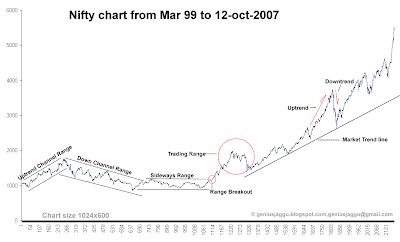
One of the most important concepts in technical analysis is that of trend.

The trend is really nothing more than the general direction in which a common stock or market is headed.

In any given chart, you will probably notice that prices do not tend to move in a straight line in any direction, but rather in a series of highs and lows. In technical analysis, it is the movement of the highs and lows that constitutes a trend.

The Importance of Trend
It is important to be able to understand and identify trends so that you can trade with rather than against them.

Two important sayings in technical analysis are "the trend is your friend" and "don't buck the trend," illustrating how important trend analysis is for technical traders.


to download above chart ,pls copy-paste entire link given below
http://lh6.google.com/geniusjaggu/RxHK87Il63I/AAAAAAAAAFU/yB_sKz2-KF0/blog%20chart1.gif

Thursday, July 26, 2007

Lesson 7:Support And Resistance

Technical Analysis: Support And Resistance

Once you understand the concept of a trend, the next major concept is that of support and resistance.

Technical analysts often talk about the ongoing battle between the bulls and the bears, or the struggle between buyers (demand) and sellers (supply). This is revealed by the prices a security seldom moves above (resistance) or below (support).

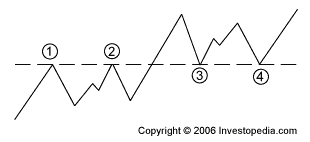
Support and resistance levels are the levels at which a lot of traders are willing to buy the stock (in the case of a support) or sell it (in the case of resistance).

When these trendlines are broken, the supply and demand and the psychology behind the stock's movements is thought to have shifted, in which case new levels of support and resistance will likely be established.


Round numbers like 10, 20, 35, 50, 100 and 1,000 tend be important in support and resistance levels because they often represent the major psychological turning points at which many traders will make buy or sell decisions.


Role Reversal

Once a resistance or support level is broken, its role is reversed. If the price falls below a support level, that level will become resistance. If the price rises above a resistance level, it will often become support. As the price moves past a level of support or resistance, it is thought that supply and demand has shifted, causing the breached level to reverse its role.

For a true reversal to occur, however, it is important that the price make a strong move through either the support or resistance with good no.of volumes.


In almost every case, a stock will have both a level of support and a level of resistance and will trade in this range as it bounces between these levels. This is most often seen when a stock is trading in a generally sideways manner as the price moves through successive peaks and troughs, testing resistance and support.


The Importance of Support and Resistance
Support and resistance are important part of trend because it can be used to make trading decisions and identify when a trend is reversing.

For example, if a trader identifies an important level of resistance that has been tested several times but never broken, he/she may decide to take profits as the security moves toward this point because it is unlikely that it will move past this level.

As long as the price of the share remains between these levels of support and resistance, the trend is likely to continue. It is important to note, however, that a break beyond a level of support or resistance does not always have to be a reversal.

For example, if prices moved above the resistance levels of an upward trending channel, the trend has accelerated, not reversed. This means that the price appreciation is expected to be faster than it was in the channel.

Traders should avoid placing orders at support and resistance points, as the area around them is usually marked by a lot of volatility.

It is important that you follow this simple rule: do not place orders directly at the support or resistance level. This is because in many cases, the price never actually reaches the whole number, but flirts with it instead.

Popular Posts for last 7 days

All Time Popular Posts